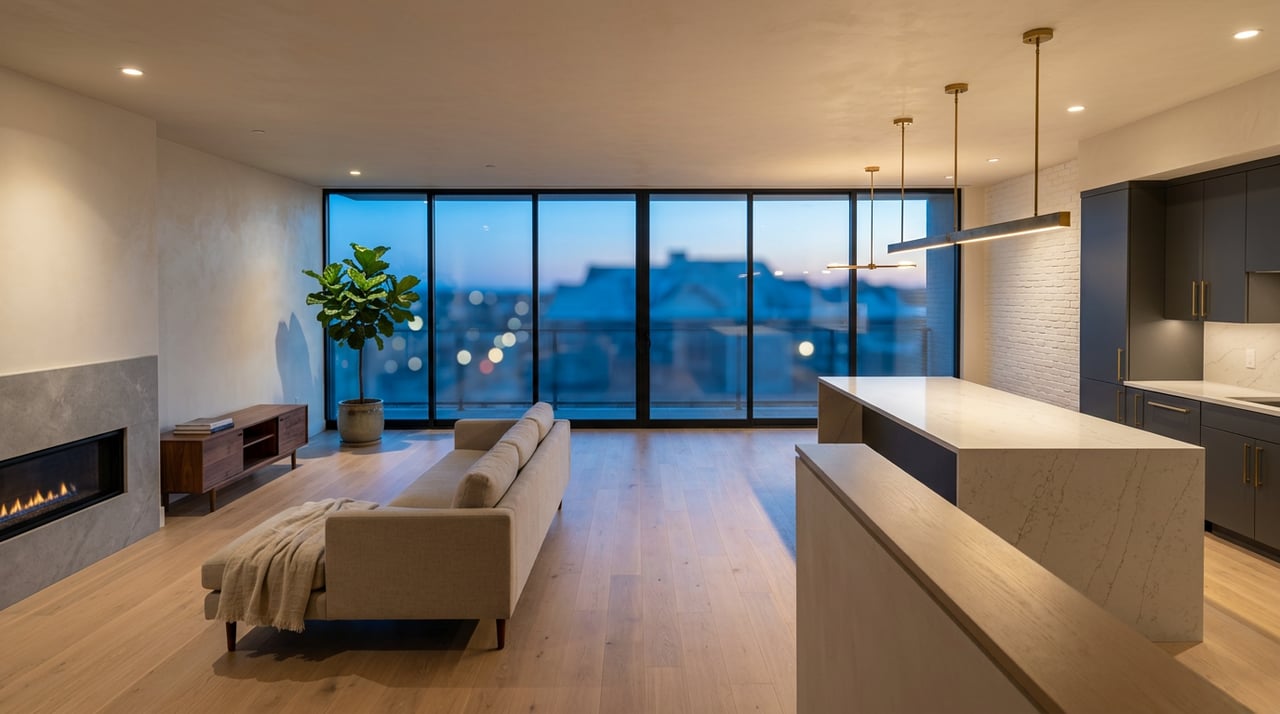
A relocating buyer touring Uptown this month can find two condos that look interchangeable on paper: same square footage, similar skyline view, list prices a few thousand dollars apart. Every number circulating about the neighborhood right now says the leverage runs their way. Prices are softer than they were a year ago. Inventory is up. Days on market have stretched out. Then the condo questionnaire comes back clean on one building and flags a pending special assessment on the other, and the two listings that looked like a coin flip an hour earlier are not close to the same decision.
That gap, not the median price on the portal, is what actually determines whether Uptown's softer numbers translate into a good purchase.
What the Region-Wide Number Actually Says
Canopy MLS data for June 2026, the most recent complete month reported by the Canopy Realtor Association, shows a Charlotte region that is normalizing rather than correcting. Closed sales held almost flat year over year at 4,304 homes. Single-family prices kept climbing, up 2.6 percent to a median of $419,650. Condos moved the opposite direction, with the median sales price down 4.8 percent to $295,000, and months of supply for condos reached 6.0, roughly double the pace of single-family homes in the same report. Townhomes sat in between: median price down 2.0 percent to $350,000, with 4.3 months of supply.
| Property type | Median price, June 2026 | Year-over-year change | Months of supply |
|---|---|---|---|
| Single-family | $419,650 | +2.6% | Under 3 months |
| Townhome | $350,000 | -2.0% | 4.3 months |
| Condo | $295,000 | -4.8% | 6.0 months |
Six months of supply is close to a textbook balanced market, tilting toward buyers. That is the regional condo story, and it is a real one. It is also not Uptown's story on its own. Uptown's condo stock is a small, distinct slice of that regional number, and it has been moving on its own schedule.
Uptown Is Falling Faster Than the Region
Over the three months ending May 2026, Uptown's median sale price came in around $378,000, down 1.9 percent from the same period a year earlier, with homes taking an average of 91 days to sell compared with 62 days the year before. That alone tells a buyer the neighborhood has slowed.
A closer look at April 2026 Canopy MLS figures specific to the Uptown submarket shows a sharper version of the same trend: inventory up 46 percent year over year, months of supply jumping from 4.7 to 7.4, median sales price down 11.2 percent to $342,000, and cumulative days on market more than doubling, from 62 to 129 days. The analysis behind those figures included an honest caveat worth repeating here: Uptown is a small enough submarket that a single month of unusual activity can swing the numbers harder than it would in a larger market like Mecklenburg County as a whole. The direction is still meaningful. It just should not be read as a precise, permanent line.
Why the Drop Looks Sharper Here
Part of the answer sits above street level, in Uptown's office towers. Vacancy in Uptown's office stock was near 25 percent as of the first quarter of 2026, according to Cushman & Wakefield data reported by Axios. That vacancy is driving one of the more significant shifts in Uptown's housing supply pipeline, and it has nothing to do with condo resale inventory directly, yet it shapes the environment buyers are shopping in.
The former Duke Energy headquarters on South Church Street, near Bank of America Stadium, is being converted into 448 apartments and 52,000 square feet of retail, with the first units expected by spring 2027. A few blocks away, the 32-story tower at 400 South Tryon fell into foreclosure in 2024 and was purchased at auction for $36 million against a tax value of $115.3 million. New owner Spandrel Development Partners has filed plans to convert it into as many as 599 apartments across the upper 25 floors, with a hotel occupying the lower floors.
Neither project adds a single condo to the for-sale market. Both are rental apartments, a different product from what a resale buyer is comparing. Their planned arrivals are part of Uptown's future housing supply; the neighborhood's resale market was already softening.
The Reserve Study Is the Real Comp
Here is the part that does not show up on a listing sheet. In South Charlotte or around Lake Norman, the housing stock is mostly single-family, and price is largely a story about the lot and the land under it. Uptown flips that. Outside a small pocket of period rowhouses in Fourth Ward, almost everything for sale in Uptown is condominium product, in towers like The Trust and The Ratcliffe in Second Ward, or The Vue and SKYE closer to the heart of the skyline.
When two units in different buildings carry the same price per square foot, the thing that is usually not equal is the financial condition of the building behind them. A tower with a fully funded reserve, a clean assessment history, and a healthy pool of recent resales is a fundamentally different purchase than a tower with the same floor plan and a thinner reserve, even if the two units look identical in photos. The premium a buyer pays for the stronger building is not vanity pricing. It is the cost of protecting the resale later, because a poorly reserved building can turn a routine roof or elevator repair into a five-figure special assessment landing on whoever owns the unit at the time.
Before comparing two Uptown listings on price alone, it is worth requesting:
- The building's most recent reserve study
- Any special assessment history from the past three to five years
- The current HOA budget and dues structure
- Closed sales within that specific stack of units over the past 12 to 24 months, not just neighborhood-wide comps
That last point matters more than it sounds. A building that has had only one or two closed sales in the past year can show a price drop that looks like a trend when it is really just one seller's circumstances. Reading the building's own sales history, rather than the Uptown aggregate, is the only way to tell the difference.
What a Fourth Ward Rowhouse Tells You About Everything Else
The exception proves the rule. Fourth Ward's small stock of period rowhouses and single-family homes is the rare non-tower product inside Uptown, and it behaves like the intown single-family enclaves elsewhere in Charlotte: it turns over slowly, holds a premium, and trades on scarcity rather than reserve health. A buyer drawn to that kind of ownership is shopping a genuinely different market than the one described above, even though both sit inside the same neighborhood boundary on a map.
What This Means If You're Comparing Neighborhoods
For a relocating household weighing an Uptown condo against a single-family home in Myers Park or a waterfront property on Lake Norman, the property-type table above is the more honest comparison than any single neighborhood median. Single-family prices in the region are still climbing. Condo prices are falling, and falling harder in Uptown than the regional number suggests. Those are two different market temperatures within a fifteen-minute drive of each other, and the right one depends on what kind of ownership, and what kind of resale risk, actually fits the plan.
A Few Questions Worth Asking
Does a lower asking price in Uptown always mean a better deal right now? Not by itself. A price that has already dropped to reflect a thin reserve or a looming assessment is not the same discount as a price drop in a financially healthy building. The building's documents, not the list price, tell you which one you are looking at.
Will the new apartment conversions push condo prices down further? It is too early to say with confidence. The first units at the Brooklyn and Church site are not expected until spring 2027, and 400 South Tryon is still in the planning stage. What is clear is that Uptown's total housing supply is set to keep expanding for at least the next two years, which is a reasonable factor to weigh for anyone buying with a multi-year hold in mind.
What should I request before comparing two Uptown listings? The reserve study, the assessment history, the HOA budget, and closed sales within that specific building over the past year or two. Neighborhood-level statistics are a starting point. The building's own paperwork is where the real comparison happens.
Uptown's softer numbers are real, and for the right building they represent genuine leverage. Sorting out which building that is takes a broker who reads condo documents as closely as square footage. If you are comparing Uptown against another Charlotte-area neighborhood, or trying to make sense of what a specific building's financials actually mean for your offer, Tiffany Johannes is glad to walk through it with you. Let's Connect.